Paris, a history spanning millennia and a heritage unique in the world
Paris, the capital of France and one of the world's most iconic cities, attracts tens of millions of visitors every year. Its rich culture, elegant architecture, must-see museums, and unique atmosphere make it a destination that profoundly shapes the collective imagination.
✨ A city born on the water
The history of Paris begins on the Île de la Cité, the original heart of the city, where the Gallic tribe of the Parisii had settled. Becoming Lutetia under the Roman Empire, it gradually developed around the Seine, a natural artery facilitating trade and traffic.
The Middle Ages saw the rise of major monuments such as Notre-Dame, the first universities, guilds, markets, and bridges that structured the city. From the 12th century onward, Paris became a political, religious, economic, and intellectual capital.
🌟 Paris, world capital of art and culture
During the Renaissance, and later under the reigns of Louis XIV and Louis XV, Paris became more beautiful:
- new palaces
- royal squares
- gardens
- avenues lined with harmonious facades
The 19th century marked a major turning point with the works of Haussmann, which transformed Paris into a modern city: grand avenues, buildings of blond stone, monumental perspectives.
In the 20th and 21st centuries, Paris became a world-renowned city:
- UNESCO protected heritage
- fashion capital
- artistic and literary capital
- European engine of culture and tourism
Today, it remains a city that is both historic and modern, where each district reveals a particular atmosphere and history.
The most visited monuments in Paris, must-see places
🕍 1. Notre-Dame de Paris: a Gothic masterpiece and a universal symbol
Notre-Dame Cathedral in Paris is one of the Europe's most iconic monuments. Built between 1163 and 1345, it testifies to the architectural genius of the Middle Ages and symbolizes nearly nine centuries of religious, political, and cultural history. Located in the heart of the Île de la Cité, it occupies the spiritual site where Paris was born. The building has witnessed generations of kings, believers, visitors, artists, and thinkers who have left their mark upon it.
Its Gothic architecture impresses with its verticality, its majestic vaults, its flying buttresses which seemed revolutionary at the time of their construction, its gargoyles watching over the roofs, and above all its monumental rose windows, true artistic feats made of glass and light. Before the 2019 fire, Notre-Dame welcomed nearly fourteen million visitors each year, which made the most visited monument in Europe.
The 2019 disaster shook the world. Yet, it also sparked a wave of international solidarity and enabled the launch of an exceptionally large-scale restoration project. Today, Notre-Dame is reborn, gradually being restored to its original splendor. Visitors can once again admire its cleaned facades, restored sculptures, and spire rebuilt according to Viollet-le-Duc's original design.
For a group, a visit to Notre-Dame is an immersion into the soul of Paris. It's also an opportunity to discover the surrounding area: Sainte-Chapelle, the Conciergerie, the banks of the Seine, or the charming Marais district.’coach allows participants to be dropped off near the island and the rest of the program to be easily organized.

More information can be found on the official Notre-Dame-de-Paris website..
🗼2. The Eiffel Tower: the monument that embodies Paris and France
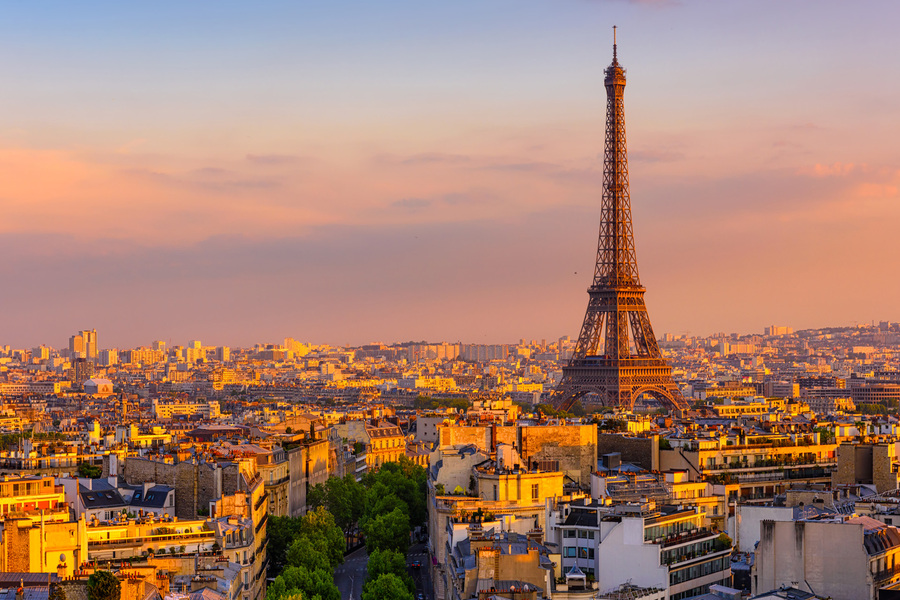
There are few monuments in the world capable of symbolizing an entire country on their own. The Eiffel Tower It belongs to that rare category. When it was designed by the engineer Gustave Eiffel and his team for the 1889 Universal Exposition, Paris was entering a new era dominated by steel, progress, and technological daring. Yet, its fate was not guaranteed: many artists of the time criticized its metallic silhouette, deeming it too modern, too imposing, or too far removed from 19th-century architectural standards. History has largely refuted these criticisms.
Today, the Eiffel Tower has become one of the the most visited monuments in the world. It attracts millions of visitors each year who come to discover Paris from its panoramic platforms. The first floor, which offers immersive spaces, exhibitions, and a famous glass floor, allows the public to enjoy a unique sensory experience. The second floor offers a harmonious panorama of the Seine quays, Les Invalides, Montmartre, and the main Haussmannian avenues. As for the summit, accessible by elevator, it is often considered the’one of the most spectacular viewpoints in Europe.
The Eiffel Tower, however, is more than just a technical marvel. It is a permanent landmark, a symbol of romance, and a marker of Parisian identity. At night, its golden sparkle creates a moment of poetry that millions of visitors capture each year. For a group, a visit to the Eiffel Tower is always a highlight, often considered an essential part of a Parisian stay, and requires careful planning given the crowds that surround it.

More information is available on the official Eiffel Tower website..
🏛️ 3. The Louvre Museum: the world's largest art collection
Housed in the former royal palace of the kings of France, the Louvre Museum It constitutes an unparalleled journey through the history of humankind. With its tens of thousands of works on display and hundreds of rooms spread across several wings, it is considered the the world's largest and most prestigious museum. The richness of its collections allows one to travel through several millennia in a few hours, from the first civilizations of Mesopotamia to the masterpieces of the Renaissance.
The Louvre is particularly famous for housing Leonardo da Vinci's Mona Lisa, but reducing this museum to this single painting would be a mistake, given the remarkable nature of its collections. Visitors can discover the Venus de Milo and the Seated Scribe, treasures from ancient Egypt, Babylonian frescoes, Greek sculptures, French paintings from the Grand Siècle, Florentine and Venetian masterpieces, and an exceptional gallery devoted to Islamic art.
The addition of the glass pyramid in 1989 marked a major transformation of the site. This luminous entrance, designed by architect Ieoh Ming Pei, opens the museum to modernity while respecting its historical architecture. The blend of stone and glass creates a harmonious dialogue between tradition and innovation that attracts millions of visitors each year, eager to experience this encounter between past and present.
For groups, visiting the Louvre requires careful planning. Due to its vast size, it is essential to define a precise itinerary, often centered on a few selected points of interest. Arrival in coach This greatly simplifies the organization, as the drop-off point is located in the immediate vicinity of the reserved entrances, thus avoiding metro transfers and the dispersal of participants. The driver is fully aware of the time constraints of the visit slots and adapts the route to guarantee a smooth and safe arrival.

More information is available on the official website of the Louvre Museum..
🏛️ 4. The Arc de Triomphe: the monument of national memory
The Arc de Triomphe, commissioned by Napoleon I after the victory at Austerlitz, majestically dominates the Place Charles-de-Gaulle. Its massive silhouette, inspired by Roman arches, symbolizes military power and national destiny. The bas-reliefs adorning its facades depict battle scenes sculpted with remarkable precision and recount the revolutionary and imperial epic.
At the foot of the monument lies the Tomb of the Unknown Soldier, installed in 1920 to honor the anonymous victims of the First World War. Since 1923, the flame of remembrance has burned there continuously, rekindled each evening during a solemn ceremony. This practice makes the Arc de Triomphe a universal place of memory, regularly visited by international delegations, veterans, students and travellers from all walks of life.
At the top, accessible after climbing more than 280 steps, the terrace offers one of the most spectacular panoramas of Paris. The twelve avenues that converge on the square form a perfect star, revealing a remarkable perspective of the Champs-Élysées, La Défense, the Eiffel Tower and the Montmartre hill.
For a circuit in coach, The Arc de Triomphe is an essential landmark. professional driver It can slowly circle the roundabout so passengers can admire the view, then offer a photo stop at a strategic point. This flexibility is particularly appreciated on panoramic city tours.

More information is available on the official Arc de Triomphe website..
🕍 5. The Sacré-Cœur Basilica: Paris's mystical balcony
The Sacré-Cœur Basilica, located at the top of Montmartre hill, is a A unique monument that combines spirituality, history, and architectural beauty.. Built at the end of the 19th century and consecrated in 1919, it is recognizable by its white silhouette standing out against the Parisian sky. Its Romano-Byzantine style contrasts with the classical buildings of the capital, giving it a unique identity.
The interior of the building houses one of the world's largest mosaics depicting Christ in glory. The sanctuary is a place of continuous prayer, making the Sacred Heart a spiritual haven open day and night. For many visitors, the basilica is a sanctuary of peace in the heart of the city.
The square in front of the Sacré-Cœur Basilica offers one of the best views of Paris. From there, the city unfolds in all its vastness. The sunsets are particularly magnificent. The Montmartre district, meanwhile, retains its village atmosphere. Its cobbled streets, steep staircases, artists' studios, and the Place du Tertre offer an authentic cultural experience where the legacy of Picasso, Modigliani, and Dalí blends with the work of contemporary painters.
For the coaches or minibuses, Montmartre presents a significant logistical challenge. The streets are narrow and access is regulated. Francebus has a thorough understanding of the authorized zones, suitable drop-off points, and optimal schedules to avoid peak periods.

More information can be found on the official website of the Basilica of the Sacred Heart..
| Monument | Opening days & hours | Notes / Visit |
|---|---|---|
| Notre-Dame de Paris | Monday – Friday: 7:50 am – 7:00 pm Thursday: 7:50 am – 10:00 pm Saturday & Sunday: 8:15 am – 7:30 pm | Free access to the cathedral (free entry). Specific times for tours and some guided visits. |
| Eiffel Tower | Every day: 9:30 AM – 11:45 PM (last ascent around 10:45 pm depending on floor) | Opening hours vary depending on the season and weather conditions. Online booking is strongly recommended for groups. |
| Louvre Museum | Monday, Thursday, Saturday, Sunday: 9:00 AM – 6:00 PM Wednesday & Friday: 9:00 AM – 9:00 PM Tuesday: Closed | Last entry approximately 1 hour before closing. Closed on certain public holidays (May 1st, December 25th, etc.). |
| Triumphal arch | October – March: 11:00 AM – 10:30 PM (last entry ~45 min before closing) | Later opening hours in summer (until the evening). Occasional closures for official ceremonies. |
| Basilica of the Sacred Heart | Every day: 6:30 am – 10:30 pm | Free entry to the basilica. Access to the dome and crypt with specific times and tickets. |
The advantages of coach travel for visiting Paris
Visiting Paris in a group requires a methodical organization. Transportation in coach or minibus is not only the most comfortable, but also the most rational, economical and secure. Paris is a magnificent city, but also a complex one. Distances between monuments can be significant, public transport is sometimes overcrowded, and connections can be difficult to manage for large groups.
The coach and minibus offer a considerable advantage It allows the group to travel together, stress-free, optimizing their visit time. This allows them to fully enjoy each monument rather than wasting long minutes in transit.
In addition, a modern coach offers a comfortable, air-conditioned, quiet and secure environment. Passengers can rest, easily regroup, and enjoy a peaceful journey, far from the hustle and bustle of the city. professional driver becomes a pillar of the organization: he knows the roads, the authorized drop-off zones, the traffic restrictions, the times to avoid, the available parking lots and the alternative routes.
The coach is also an educational tool for the school groups. Students can listen to the guide's or teacher's explanations via an internal audio system. This prevents distractions and helps maintain essential cohesion.
The routes in coach or minibus The options for sightseeing tours in Paris are varied. A panoramic tour can begin at the Trocadéro, continue towards Les Invalides, the Seine, Place de la Concorde, the Opéra Garnier, the Louvre, and end in Montmartre. Foreign groups particularly appreciate this approach, which allows them to get a comprehensive view of the city in a single day.
For seminars, VIP groups or international delegations, the coach becomes a essential logistics solution. It provides fast transfers between hotels, train stations, airports, and event venues. Businesses find it a reliable way to transport employees during conventions or business trips.
Discover our coach hire options in Paris.
🚌 Why choose Francebus for your travels in Paris?
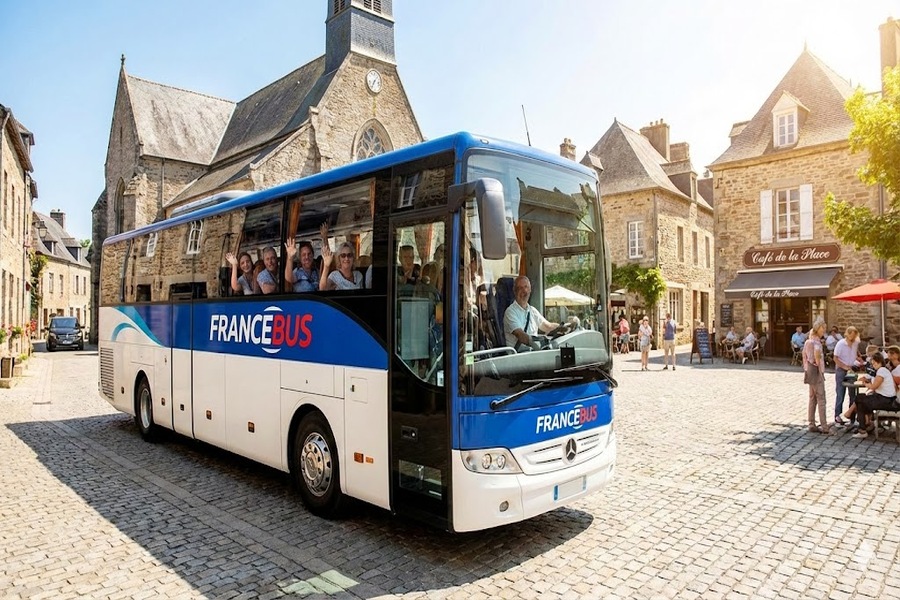
Francebus is a renowned actor group transport in France and Europe. The company has established itself thanks to its professionalism, the quality of its fleet, and the expertise of its drivers. For Paris, where traffic is complex and regulations are numerous, Francebus stands out because of its mastery of the terrain.
There Francebus fleet East varied, modern and perfectly adapted to the needs of the groups. The minibus allow navigation in narrower neighborhoods, while the coaches «"Grand touring" vehicles offer optimal comfort for long stays. All vehicles are air-conditioned, regularly maintained, equipped with comfortable seats and have sufficient space for the luggage. Francebus offers:
- Minivans: 8 seats
- minibus: 19 seats
- midibus: 35 seats
- Coaches: 49 seats and more
The drivers, professionals, They are specially trained to drive in Paris. They know the best routes, can anticipate traffic, are familiar with coach zones, and work in collaboration with organizers to guarantee a smooth flow. Their courtesy and sense of service are regularly praised by customers.
Francebus also offers tailor-made itineraries. Each group is unique, and our consultants develop... adapted programs :
- cultural visits
- panoramic city tours
- themed tours
- days in the Paris region
- airport transfers or event evenings
This personalized approach makes all the difference and guarantees a perfectly optimized experience.
Travel agencies, wedding planners, schools, companies and foreign tour operators choose Francebus for its reliability, responsiveness and quality of support. From the initial quote to the group's final return, Francebus guarantees comprehensive support. comprehensive, transparent and professional.
In a city like Paris, logistics leave no room for improvisation. Francebus is committed to offering a premium service, adapted to both the requirements of visitors and those of the terrain.
Our goal is simple: to allow the group to fully enjoy Paris, without constraints, in complete safety and in the best conditions.
Request your free quote online.
Here are some sample prices in Paris: (prices without obligation)
| Pick-up location | Drop-off location | Vehicle type | Itinerary | Prices |
|---|---|---|---|---|
| Coach | € | |||
| Coach | € | |||
| Minibus | € | |||
| Minibus | € |
Discover the 11 best day trip destinations from Paris.
Discover Paris, a prestigious and strategic destination for a seminar.